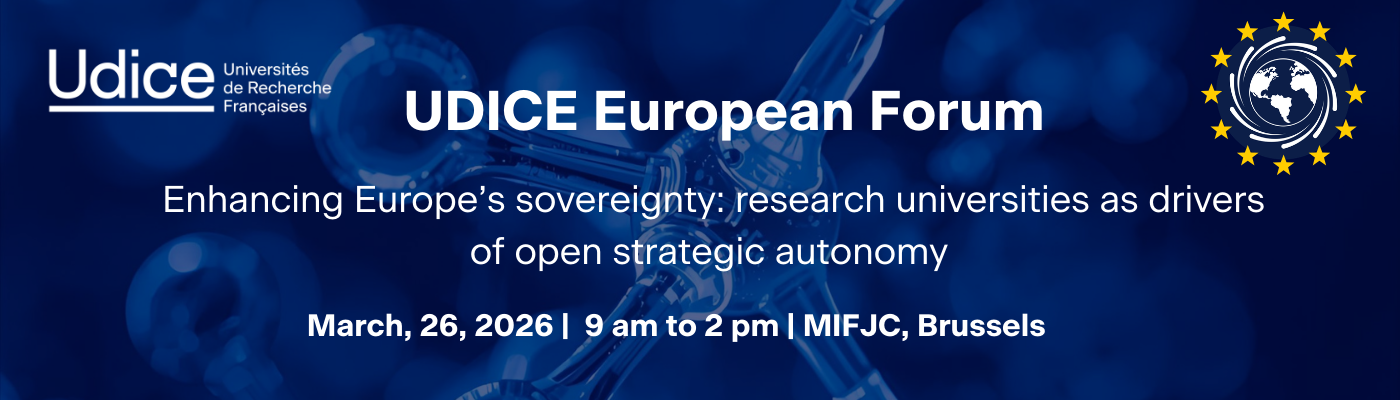
Enhancing Europe’s sovereignty: research universities as drivers of open strategic autonomy
Europe stands at a decisive moment in its history, as highlighted by the Draghi and Letta reports. Scientific and technological sovereignty is now a prerequisite for Europe’s future, in an increasingly fragmented global landscape. Europe must strengthen its open strategic autonomy, fostering international cooperation while securing leadership in critical technologies.
Research-intensive universities are central to this ambition. They drive academic excellence, anchor innovation ecosystems, and train the talent essential to long-term competitiveness. The emphasis today is moving from discussion to concrete action: defining a clear roadmap that matches Europe’s ambitions with the necessary means.
The European Union prepares its next Framework Programme for 2028, alongside consultations on the Multiannual Financial Framework (MFF) and the European Competitiveness Fund (ECF) which are reshaping priorities for research, innovation, and technological sovereignty. This forum aims to inform these debates and to demonstrate—through the example of research-intensive universities—the decisive role of higher education and research in building Europe’s future.
Udice is fully committed to contributing to these structuring discussions on key priorities, to ensure that the voice of research-intensive universities is clearly reflected in the policies shaping Europe’s scientific, technological, and economic future.
Roundtable 1: Europe of knowledge in motion: research universities as a lever for scientific and technological sovereignty
As Europe redefines the foundations of its sovereignty, research-intensive universities are key engines of transformation. They generate knowledge and innovation, connect science and industry, and deliver solutions to Europe’s major challenges— from clean energy and industrial decarbonisation to digital leadership, health and biotechnology.
Bringing together researchers, industry and innovation leaders, this roundtable will highlight how research excellence translates into concrete impact, and how Europe’s universities uniquely combine scientific excellence, strong territorial anchoring and industrial ambition to build a sustainable and resilient sovereignty rooted in European values.
Roundtable 2: Think, Train, Transform: turning talent into Europe’s AI advantage
To train, attract and transform: this is the mission of research-intensive universities in a Europe determined to shape its own future. This roundtable will explore how universities anticipate skills needs and develop the talent driving advances in artificial intelligence.
It will highlight the central role of the education–research–innovation continuum in strengthening Europe’s digital sovereignty, attracting top talent, and translating skills into value for industry.
Drawing on examples from across Europe, it will show how this dynamic creates value chains, attracts top talent, and enhances the attractiveness of the European model.
Speakers will include:
Keynote speaker: Guillaume KLOSSA, President of EuropaNova & Conclave
Opening remarks:
- Nathalie DRACH-TEMAM, President of Udice, President of Sorbonne University
- Bruno TOBBACK, MEP
Talks: Bruno BONNEL (online), SGPI; Alexandr HOBZA, Cabinet of EVP Stéphane Séjourné, European Commission; Silvia LASALA, Université de Lorraine; Benoît MIRAMOND, DuranceAI (Unica); Tristan MEUNIER, Quobly; Axel LEISENBERG, European Commission; Axel SCHÖLMERICH (online), German U15, University of Göttingen; Frédérique BERROD, Udice, University of Strasbourg; Katja SCHENKE-LAYLAND, German U15, University of Tübingen; Stefan LEIJNEN, AIC4NL (Unica).
Concluding remarks: El Mouhoub MOUHOUD, President of PSL University, Udice.
Moderator: Maryline FIASCHI, Science Business.
Practical information:
Thursday 26 March 2026
Bruxelles, Maison Irène et Frédéric Joliot-Curie
100, rue du Trône 1050 Bruxelles
Programme
From 9am to 2pm C.E.T
8.30-9.30 : Coffee and registration
9.30-9.45 : Opening remarks
9.45-10.15: Keynote
10.15-11.00 : Round Table 1
11.00-11.30 : Coffee break
11.30-12.15 : Round Table 2
12.15-12.30 : Wrap-up session
12.30-12.45 : Concluding remarks
12.45-14.00 : Lunch and networking
Contacts:
- Hadiatoullaye DIALLO | Head of communication
- Carole CHAPIN | Head of international relations